
Housekeeping & Stewarding Equipment for Hotels & Hospitality Projects
Operational Equipment Procurement for Efficient Room Servicing, Linen Handling, Cleaning, Hygiene, and Back-of-House Support
OSE Project Supply supports hotels, resorts, serviced apartments, and hospitality developments with housekeeping and stewarding equipment selected around room-service workflows, linen movement, cleaning routines, storage requirements, hygiene standards, staff handling, and daily operating intensity.
From room attendant carts and linen trolleys to cleaning equipment, waste-handling systems, signage, and stewarding support items, each product is specified to improve operational efficiency and simplify repeated daily service.
What Is Included in Housekeeping & Stewarding Equipment?
Housekeeping and stewarding equipment covers the carts, trolleys, cleaning tools, storage systems, waste-handling products, hygiene equipment, and operational support items used throughout guestroom service and back-of-house areas.
The exact equipment mix depends on property size, floor layout, room count, linen flow, cleaning routines, waste-handling requirements, service routes, storage capacity, and the operating standards of the hotel.
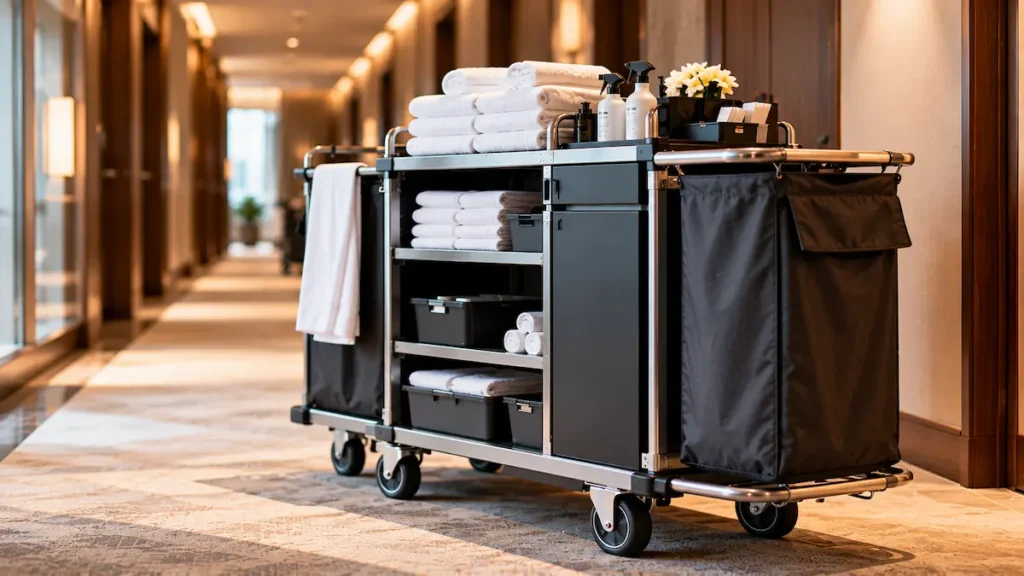
01 — Room Attendant Carts & Service Trolleys
Room attendant carts, housekeeping trolleys, maid carts, amenity carts, and related service equipment used to transport linen, amenities, cleaning supplies, waste bags, and room-reset items between guestrooms.
Equipment should balance capacity with corridor width, lift dimensions, staff handling, storage footprint, and daily service intensity.
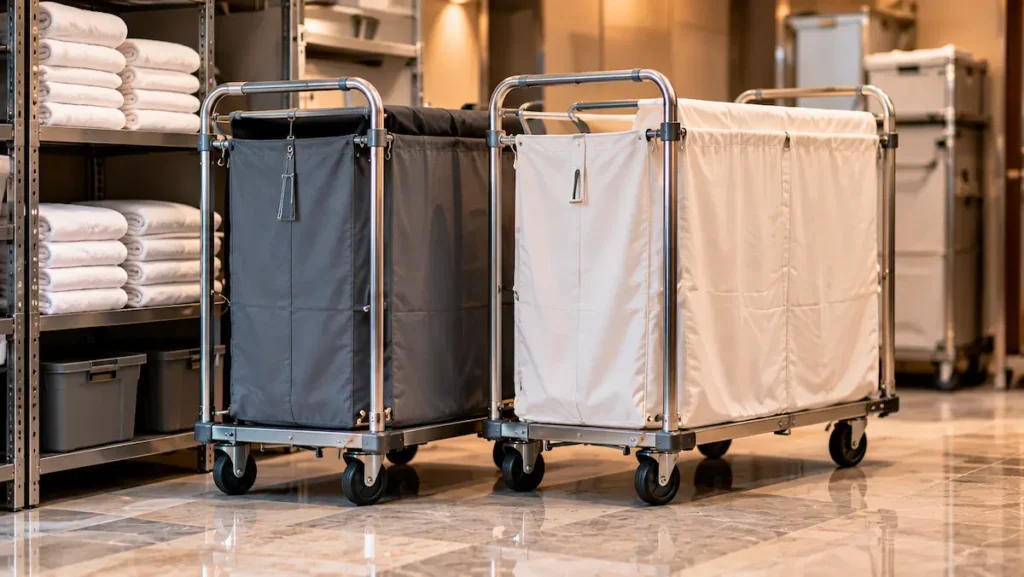
02 — Linen, Laundry & Collection Trolleys
Clean-linen carts, soiled-linen trolleys, laundry bags, collection carts, sorting systems, and transport equipment used to move textiles between guest floors, laundry areas, storage rooms, and service zones.
Capacity, separation, manoeuvrability, and hygienic handling should be considered during specification.
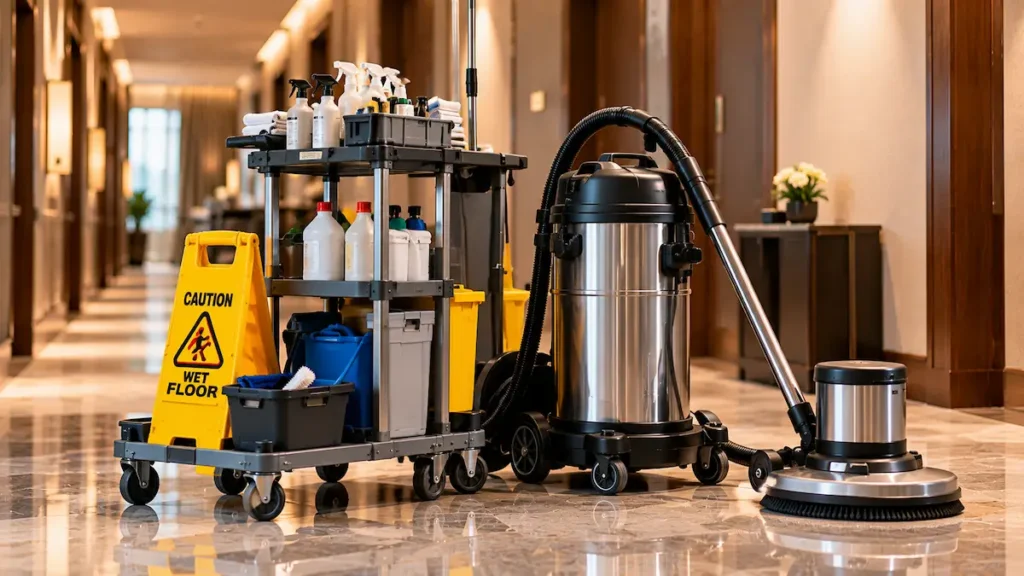
03 — Cleaning Tools & Floor-Care Equipment
Mops, buckets, wringers, brushes, dusting tools, vacuum cleaners, carpet-care equipment, floor machines, cleaning caddies, and related products used for routine and deep-cleaning operations.
Equipment should reflect floor finishes, cleaning frequency, property size, and the operational capability of housekeeping teams.
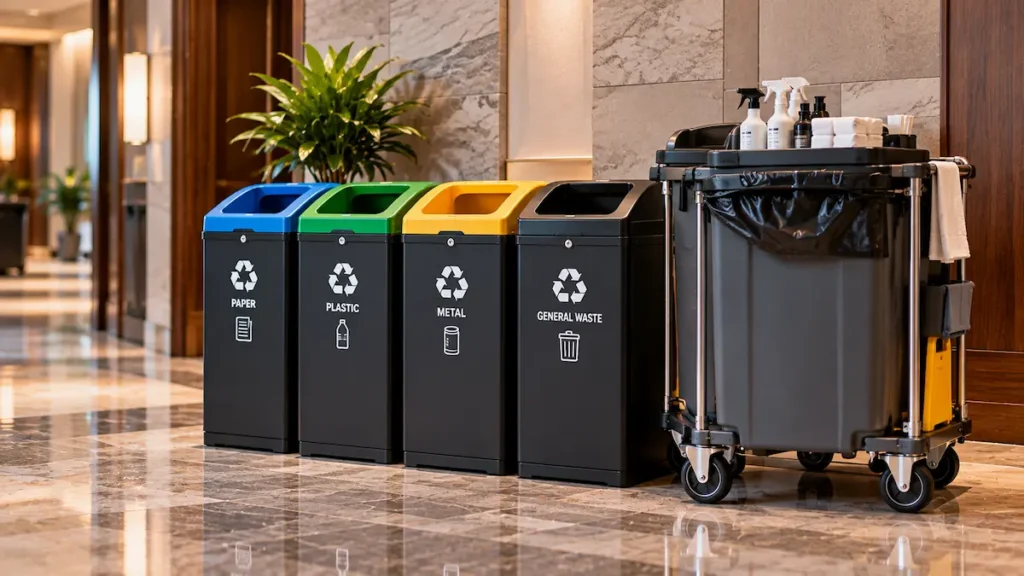
04 — Waste Handling & Hygiene Support
Waste bins, collection carts, refuse trolleys, bag holders, recycling systems, cleaning signs, spill-response items, and hygiene-support products used throughout guestrooms and back-of-house areas.
The objective is to support safe segregation, controlled movement, and efficient disposal without disrupting guest areas.
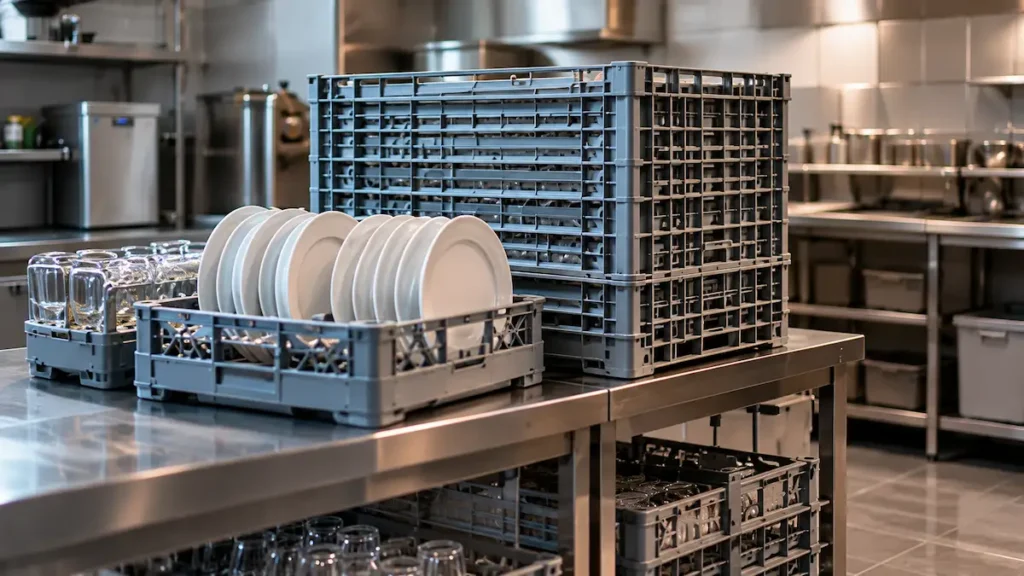
05 — Stewarding & Back-of-House Support Equipment
Dish racks, plate racks, glass racks, tray handling equipment, mobile shelving, utility carts, soaking containers, cleaning tools, and support items used around dishwashing, pot-wash, banquet, and kitchen stewarding operations.
These items should support hygienic handling, fast turnaround, and organised movement between service, washing, and storage areas.
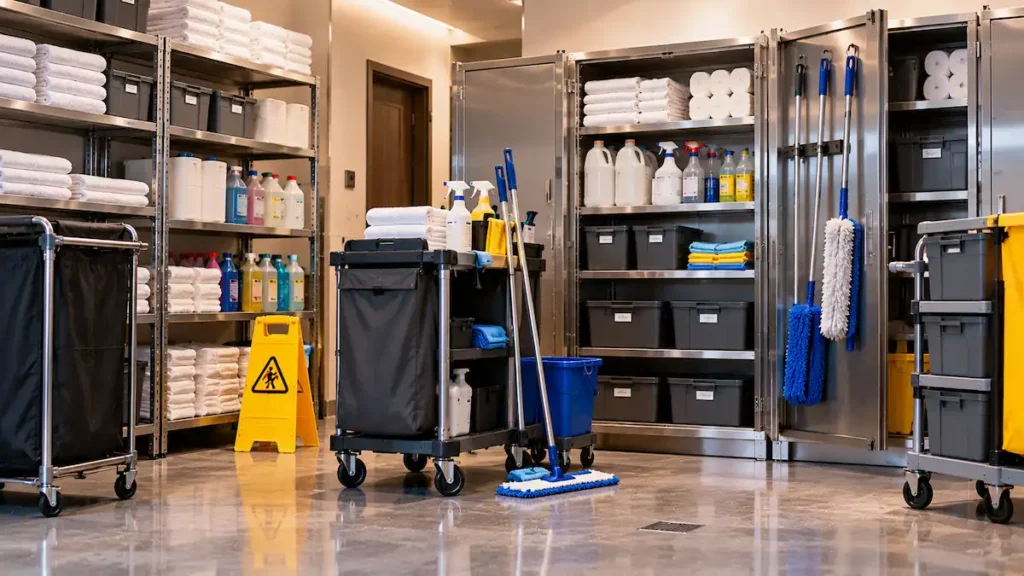
06 — Storage, Organisation & Service Accessories
Shelving, chemical storage units, utility bins, janitorial organisers, wall-mounted holders, service-room accessories, mop racks, tool storage, and other items used to keep operational areas controlled and accessible.
Good organisation reduces unnecessary movement, improves safety, and helps standardise daily housekeeping and stewarding routines.
PROCUREMENT NOTE
Housekeeping and stewarding equipment should be selected around operational flow—not simply by individual product category.
Each item should support a defined movement, cleaning, storage, hygiene, or service function while remaining practical for staff to handle, clean, store, and replace.
Matching Housekeeping & Stewarding Equipment to Operational Workflow
Housekeeping and stewarding equipment should be selected according to how linen, cleaning supplies, waste, room amenities, tableware, and operating equipment actually move through the property.
A workflow-based approach helps reduce unnecessary handling, improve hygiene separation, shorten service routes, and keep the correct equipment available at the right stage of daily operations.
01
Floor Preparation & Supply Loading
Room attendant carts and service trolleys should be prepared with the linen, amenities, cleaning supplies, and replacement items required for the planned room-service cycle.
The objective is to minimise repeated returns to floor pantries or service rooms during active servicing.
02
Guestroom Servicing & Room Reset
Housekeeping carts, cleaning tools, waste bags, linen compartments, and amenity storage should support a logical sequence of stripping, cleaning, replenishment, and room reset.
Frequently used items should remain easy to reach without creating excessive trolley clutter.
03
Linen Collection & Transfer
Clean and soiled linen should move through clearly separated handling routes wherever practical.
Dedicated linen carts, collection bags, sorting systems, and transfer equipment help support hygiene control and more efficient movement between floors, laundry, and storage areas.
04
Deep Cleaning & Floor Care
Vacuuming, carpet care, hard-floor cleaning, polishing, and periodic deep-cleaning tasks require equipment that can be deployed without disrupting normal room-service operations.
Floor machines, vacuums, mop systems, warning signs, and cleaning carts should be allocated according to surface type and cleaning frequency.
05
Stewarding, Washing & Equipment Return
Dish racks, plate racks, glass racks, utility carts, and handling equipment should support the movement of operating equipment between service areas, dishwashing, drying, and storage.
A controlled return flow helps reduce breakage, congestion, and uncontrolled movement of clean and dirty items.
06
Waste Collection & Back-of-House Transfer
Guestroom waste, recycling, cleaning waste, and stewarding refuse should move through designated containers and service routes.
Collection equipment should support segregation, containment, manoeuvrability, and efficient transfer without interfering with guest circulation.
Workflow Principle
The right equipment should follow the operational flow—not force staff to work around the equipment.
A coordinated housekeeping and stewarding setup reduces unnecessary movement while improving hygiene, handling efficiency, room turnaround, and back-of-house organisation.
Planning Trolleys, Storage & Service Routes for Efficient Operations
Housekeeping and stewarding efficiency depends heavily on how equipment moves through corridors, service lifts, floor pantries, linen rooms, laundry areas, kitchens, dishwashing zones, and waste routes.
Trolleys and support equipment should therefore be selected according to actual movement paths, storage conditions, operating volume, and the physical constraints of the property.
01
Match Trolley Size to Corridors & Service Lifts
Room attendant carts, linen trolleys, waste carts, and stewarding equipment should fit comfortably through service corridors, doorways, and lifts.
Capacity should be balanced with manoeuvrability rather than maximised without considering the building layout.
02
Allocate Equipment by Floor & Service Zone
Large properties should avoid unnecessary movement of shared equipment between distant operating areas.
Housekeeping carts, linen trolleys, floor-care equipment, and utility carts can be allocated according to floor count, room density, service zones, and operational frequency.
03
Separate Clean, Soiled & Waste Flows
Clean linen, used linen, waste, cleaning chemicals, and foodservice equipment should not move through the property as one uncontrolled flow.
Dedicated carts, containers, and service routes help improve hygiene control and operational organisation.
04
Plan Floor Pantry & Storage Capacity
Trolleys require practical parking and replenishment space when they are not actively being used.
Floor pantries, housekeeping stores, stewarding areas, and back-of-house rooms should accommodate equipment without blocking circulation or access to supplies.
05
Reduce Unnecessary Travel Distance
Poorly positioned stores and incorrectly allocated equipment can create significant staff movement during every shift.
Locating high-use equipment closer to the areas it serves can improve productivity and reduce repeated travel between floors and back-of-house departments.
06
Consider Wheels, Turning Radius & Handling
Trolley performance is influenced by more than storage capacity.
Wheel diameter, swivel performance, braking, handle position, trolley width, turning radius, floor transitions, and loaded weight all affect daily staff handling.
Standardisation Principle
The largest trolley is not always the most efficient trolley.
The best equipment configuration balances capacity, manoeuvrability, storage footprint, service-route compatibility, and the operating needs of each zone.
Avoiding Housekeeping & Stewarding Specification Problems
Many housekeeping and stewarding problems appear only after equipment enters daily service and begins moving repeatedly through corridors, lifts, pantries, laundry areas, dishwashing zones, and waste routes.
Poor trolley sizing, unsuitable wheels, insufficient capacity, weak hygiene separation, and inefficient storage planning can increase labour, slow room turnaround, and create unnecessary operating complexity.
Choosing Oversized Trolleys
A trolley with maximum capacity is not always the most practical choice.
Oversized carts can create difficulties in narrow corridors, service lifts, doorways, floor pantries, and turning areas.
Operational Consequence
Slower movement, blocked circulation, difficult handling, and inefficient room servicing.
Ignoring Wheel & Manoeuvrability Requirements
Wheel quality, diameter, swivel performance, braking, and loaded turning radius directly affect daily trolley handling.
Equipment that performs well when empty may become difficult to control when fully loaded.
Operational Consequence
Higher staff effort, slower movement, floor damage, and increased equipment wear.
Underestimating Linen & Supply Capacity
Insufficient trolley capacity can force housekeeping teams to make repeated trips for linen, amenities, cleaning supplies, or replacement items.
Capacity should be based on actual room-service cycles rather than only trolley dimensions.
Operational Consequence
More replenishment trips, lower productivity, and longer room turnaround.
Mixing Clean, Soiled & Waste Functions
Using the same uncontrolled equipment flow for clean linen, used linen, waste, chemicals, and service items can compromise hygiene and organisation.
Where practical, dedicated carts, bags, compartments, and transfer routes should be used.
Operational Consequence
Increased contamination risk, poor workflow control, and more complex daily operations.
Selecting Equipment That Is Difficult to Clean
Housekeeping and stewarding equipment is exposed to moisture, chemicals, waste, food residue, and repeated handling.
Complex joints, inaccessible surfaces, absorbent materials, or corrosion-prone components can make routine sanitation more difficult.
Operational Consequence
Longer cleaning time, reduced hygiene performance, and shorter equipment life.
Failing to Plan Storage & Parking Space
Trolleys, floor-care equipment, waste carts, and utility equipment require dedicated storage when not in use.
Buying equipment without checking pantry, service-room, and back-of-house space can create overcrowded operating areas.
Operational Consequence
Blocked access, poor organisation, equipment damage, and inefficient staff movement.
Operational Consequence
Poor housekeeping and stewarding specification creates operational friction across every shift.
When repeated across multiple floors and departments, small handling, storage, hygiene, and capacity problems can significantly increase labour requirements and reduce service efficiency.
Related Procurement Support for Housekeeping & Stewarding Equipment
Housekeeping and stewarding equipment is often procured alongside guestroom OS&E, back-of-house storage, laundry support, waste-handling systems, and wider hotel operating equipment.
Coordinating these requirements can improve equipment compatibility, quantity planning, storage efficiency, hygiene control, supplier management, and project delivery.
01
Hotel OS&E Procurement Services
Integrate Housekeeping & Stewarding Equipment Into the Wider OS&E Package
Coordinate housekeeping carts, linen handling, cleaning equipment, stewarding support, waste systems, and operational accessories within the wider hotel or resort OS&E scope.
Explore Solution →
02
Guestroom OS&E
Coordinate Housekeeping Operations With Guestroom Standards
Align housekeeping equipment, room replenishment routines, linen movement, and service accessories with the guestroom OS&E package and room-reset requirements.
Explore Solution →
03
BOQ Procurement & Cost Optimization
Review Equipment Quantities, Capacities, and Operational Compatibility
Identify oversized or undersized equipment, trolley gaps, unnecessary product variation, storage constraints, and opportunities to improve procurement efficiency before ordering.
Explore Solution →
04
Global Procurement & Logistics Coordination
Coordinate Multi-Supplier Housekeeping & Back-of-House Deliveries
Support supplier follow-up, order consolidation, export documentation, shipment planning, and phased delivery coordination across housekeeping, stewarding, and wider hotel OS&E packages.
Explore Solution →
Depending on project scope, these services can be used individually or combined into a coordinated procurement strategy covering housekeeping, stewarding, wider OS&E requirements, cost control, and international project delivery.
Housekeeping & Stewarding Equipment FAQs
PLANNING A HOUSEKEEPING OR STEWARDING EQUIPMENT PACKAGE?
Build a More Efficient Housekeeping & Stewarding Equipment Package
Whether you are planning a hotel, resort, serviced apartment, or large hospitality development, OSE Project Supply can support equipment specification review, trolley planning, quantity validation, workflow coordination, supplier evaluation, sourcing, and coordinated project supply.
Explore Our OS&E Categories →
Efficient movement. Better hygiene control. Smarter storage. Reliable sourcing.