
Professional Barware
for Hotels, Bars &
Hospitality Projects
Commercial Barware Procurement
for Faster Service, Consistent Preparation,
and Efficient Bar Operations
OSE Project Supply supports hotels, resorts, restaurants, bars,
and hospitality projects with professional barware selected
around beverage menus, bar station workflows, service intensity,
portion control, durability, and replacement requirements.
From cocktail preparation and measuring tools
to ice handling, garnish accessories, wine service items,
and bar station organisers, each item is specified
to support efficient daily beverage service.
What Is Included in Professional Barware?
Professional barware covers the operational tools and service accessories used to prepare, measure, mix, chill, garnish, pour, and present beverages efficiently in commercial hospitality environments.
The exact barware mix depends on beverage menu, outlet concept, service volume, bar station layout, staff workflow, glassware range, and the level of standardisation required across the operation.
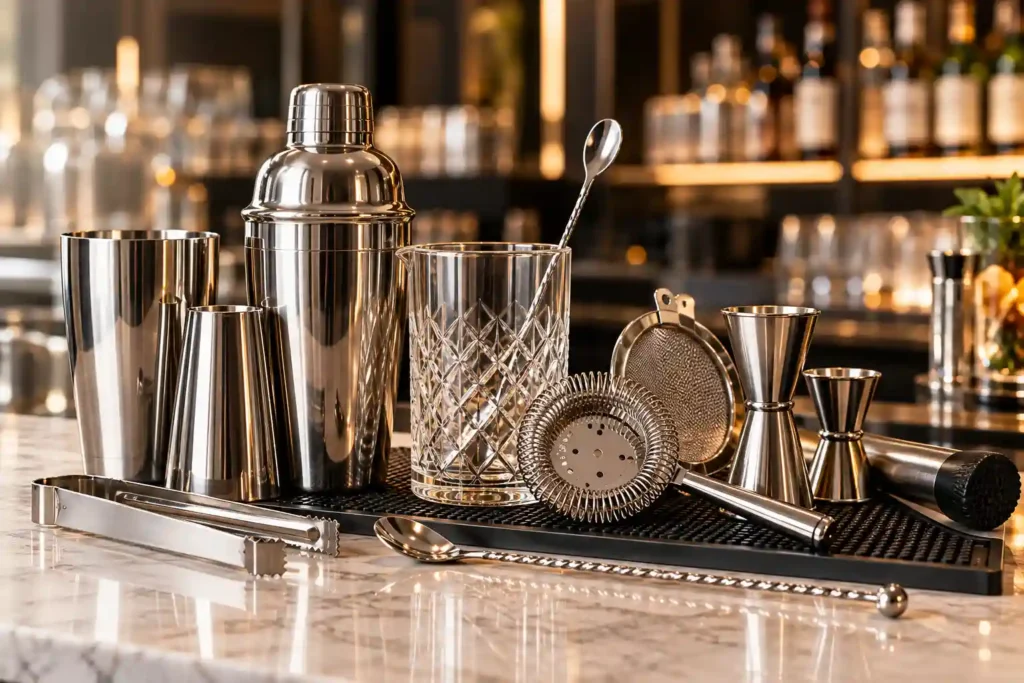
Cocktail Mixing & Measuring Tools
Shakers, mixing glasses, bar spoons, muddlers, strainers, jiggers, measuring cups, pourers, and other tools used for accurate measuring, shaking, stirring, muddling, and mixing beverages.
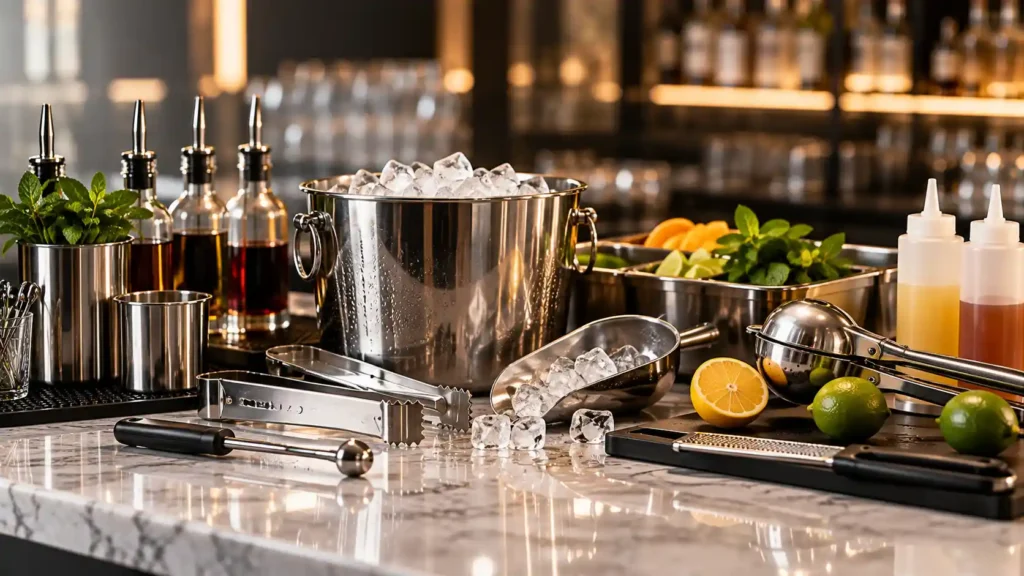
Ice Handling & Beverage Preparation Tools
Ice scoops, tongs, picks, buckets, citrus presses, peelers, zesters, garnish knives, cutting boards, squeeze bottles, and related tools for efficient beverage preparation and hygienic ice handling.

Wine, Bottle & Service Accessories
Corkscrews, bottle openers, foil cutters, wine stoppers, pourers, aerators, decanting accessories, and related service tools used across wine and bottled beverage service.
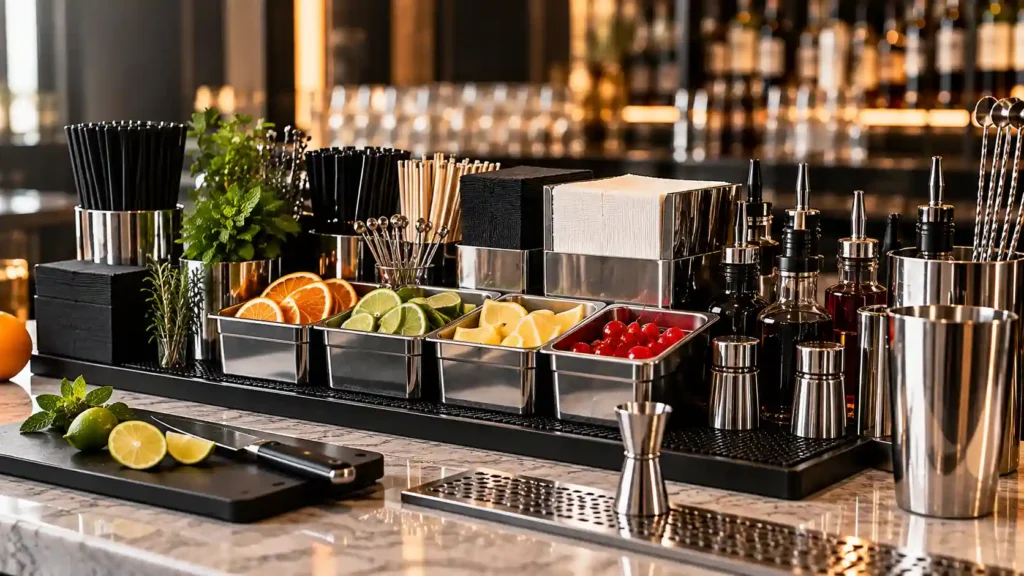
Bar Station Organisation & Service Support
Bar mats, drip trays, condiment organisers, straw holders, napkin dispensers, bottle organisers, speed-rail accessories, and other workstation support items designed to keep bar stations efficient and organised.
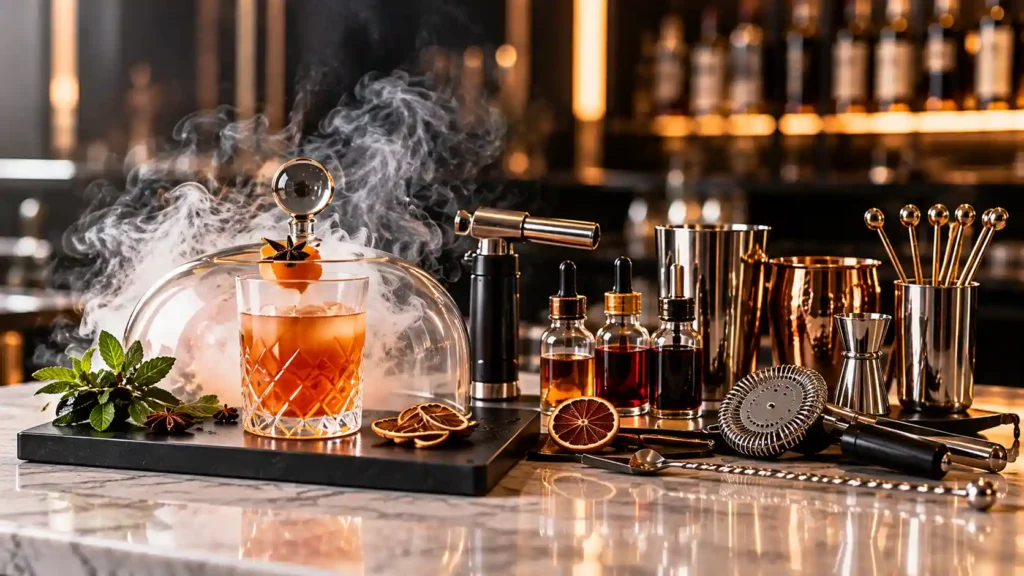
Specialty Cocktail & Presentation Accessories
Cocktail picks, bitters bottles, atomisers, smoking accessories, specialty strainers, presentation tools, and selected items required for concept-specific beverage preparation and service.
PROCUREMENT NOTE
A professional barware package should reflect the beverage programme and station workflow—not simply the longest possible product list.
Each item should support a defined preparation task, service function, station requirement, or presentation standard within the operation.
Matching Barware to the Beverage Service Workflow
01
Preparation & Station Setup
Garnish tools, cutting boards, squeeze bottles, condiment containers, pourers, and preparation accessories should be organised before service begins.
The objective is to minimise preparation work during peak operating periods.
02
Measuring & Portion Control
Jiggers, measuring tools, and controlled pourers help bartenders reproduce recipes consistently while supporting beverage yield and portion accuracy.
Standardising commonly used measurements can also simplify staff training across multiple stations.
03
Mixing & Chilling
Shakers, mixing glasses, strainers, bar spoons, muddlers, and ice tools should be positioned according to the beverage menu and the methods used most frequently at each station.
High-use tools should remain immediately accessible during service.
04
Ice Handling
Ice scoops, tongs, buckets, and related accessories should support hygienic transfer while reducing unnecessary movement between the ice source and preparation area.
Ice handling requirements may vary significantly between cocktail bars, pool bars, banquet service, and high-volume outlets.
05
Garnishing & Finishing
Prepared garnishes, picks, peelers, zesters, atomisers, and finishing accessories should support fast and consistent presentation without interrupting the service sequence.
Speciality presentation tools should be allocated only where the beverage programme requires them.
06
Beverage Service
Bottle openers, wine tools, pourers, service accessories, and presentation items should be positioned according to how beverages move from preparation to guest service.
The final setup should support both speed and presentation standards.
07
Reset & Replenishment
Bar mats, organisers, storage containers, replacement tools, and replenishment stock help return the station quickly to service between operating cycles.
A well-organised reset process also reduces missing items and uncontrolled tool movement between stations.
Bar Station Planning & Standardisation for Faster Service
Efficient beverage service depends not only on the quality of the tools, but also on how each bar station is organised, duplicated, and standardised.
A well-planned station keeps high-use items within easy reach, reduces unnecessary movement, improves portion consistency, and helps bartenders work with the same setup across shifts and outlets.
01
Position High-Use Tools Within Reach
Shakers, jiggers, strainers, bar spoons, ice tools, and pourers should be positioned according to frequency of use and service sequence.
Frequently used tools should not require repeated reaching, crossing, or movement away from the active preparation area.
02
Standardise Measuring Tools
Common jigger sizes and portion-control tools should be consistent across stations wherever practical.
This supports recipe accuracy, beverage cost control, faster training, and more consistent service between bartenders.
03
Duplicate Essential Tools by Station
Peak-service bars should not depend on staff sharing critical tools between workstations.
Core items such as shakers, strainers, jiggers, bar spoons, openers, and ice tools should be allocated according to the number of active service positions.
04
Separate High-Use and Specialty Tools
Every station needs the tools used repeatedly throughout service, but specialist items should only be placed where the beverage menu requires them.
This reduces clutter while preserving access to concept-specific equipment.
05
Plan Ice, Garnish & Replenishment Zones
Ice, garnishes, pourers, napkins, straws, and frequently replenished items should be positioned to minimise interruptions during service.
The station should allow quick refill and reset without interfering with active drink preparation.
06
Standardise Across Multiple Outlets
Hotels and resorts with several bars can benefit from consistent core tool sets, measuring standards, storage logic, and replacement models.
Outlet-specific variations can then be added only where the beverage concept requires them.
STATION PLANNING PRINCIPLE
Standardisation should simplify the bar—not restrict it.
A strong barware standard defines the core tools every station needs while allowing controlled variations for different menus, concepts, and service styles.
Avoiding Barware Specification & Procurement Problems
Barware problems often appear after opening, when inconsistent tools, poor station allocation, unnecessary product variation, and limited replacement availability begin to affect service speed and beverage consistency.
A more disciplined specification approach helps reduce these issues before purchasing begins.
Inconsistent Jigger & Measurement Standards
Using different jigger sizes or measurement conventions across stations can reduce recipe consistency and make staff training more difficult.
Common measurement standards should be defined for the core beverage programme wherever practical.
Too Many Cocktail Tool Variants
Specifying multiple versions of shakers, strainers, spoons, muddlers, and other frequently used tools can complicate storage, inventory control, and replacement.
Core barware should be rationalised around actual operational requirements.
Insufficient Duplicate Sets for Peak Service
High-volume bars may require duplicate sets of frequently used tools at each active service position.
Relying on shared shakers, jiggers, openers, or strainers can create unnecessary movement and service delays.
Poor Ice & Garnish Tool Allocation
Ice handling and garnish preparation tools should be located close to the workstations where they are actually used.
Poor allocation can create repeated staff movement, workstation congestion, and slower drink preparation.
Over-Specifying Specialty Cocktail Tools
Specialised presentation and cocktail tools can support a specific beverage concept, but they should not be added without a defined menu requirement.
Low-use specialty products increase purchasing cost, storage demand, and inventory complexity.
Ignoring Replacement Continuity
Frequently used bar tools are exposed to wear, loss, and damage.
Selecting unusual sizes, finishes, or hard-to-source models can make future replacement more difficult and result in inconsistent station setups over time.
Risk Summary
Service Risk
Slower preparation, unnecessary movement, and inconsistent station performance.
Consistency Risk
Different measurements, tool setups, and preparation methods across bartenders or outlets.
Procurement Risk
Excessive SKUs, low-use items, and difficult future replacement.
PROCUREMENT INSIGHT
A barware package should remain easy to operate, control, and replace after opening.
Good specification reduces unnecessary variation while protecting the tools and flexibility required by the actual beverage programme.
Related Procurement Support for Professional Barware
Professional barware is often procured alongside wider hotel OS&E, beverage service, kitchen, and hospitality requirements. The following OSE services can support related project needs.
01
Hotel OS&E Procurement Services
Integrate Barware Into the Wider OS&E Package
Coordinate professional barware with the wider hotel or resort OS&E scope to improve specification alignment, purchasing efficiency, supplier coordination, and project delivery.
Explore Solution →
02
Hotel Tableware
Coordinate Beverage Service With the Wider Tabletop Programme
Align barware requirements with glassware, tabletop accessories, beverage service items, and outlet presentation standards across restaurants, lounges, and bars.
Explore Solution →
03
BOQ Procurement & Cost Optimization
Review Barware Specifications, Quantities, and Standardisation
Identify unnecessary variants, quantity gaps, inconsistent specifications, and opportunities to improve procurement efficiency before purchasing begins.
Explore Solution →
04
Global Procurement & Logistics Coordination
Coordinate Multi-Supplier Sourcing and International Delivery
Support supplier follow-up, order consolidation, documentation, shipment planning, and delivery coordination for barware and wider hospitality OS&E packages.
Explore Solution →
Depending on project scope, these services can be used individually or combined to support a coordinated beverage service and hospitality procurement strategy.
Professional Barware FAQs
PLANNING A PROFESSIONAL BARWARE PACKAGE?
Build a More Efficient Barware Package for Your Hospitality Project
Whether you are preparing a new hotel, resort, restaurant, or bar project, OSE Project Supply can support barware specification review, station planning, quantity validation, supplier evaluation, sourcing, and coordinated project supply.
Explore Our OS&E Categories →
Efficient stations. Consistent portions. Standardised tools. Reliable sourcing.